Wednesday, June 14, 2017

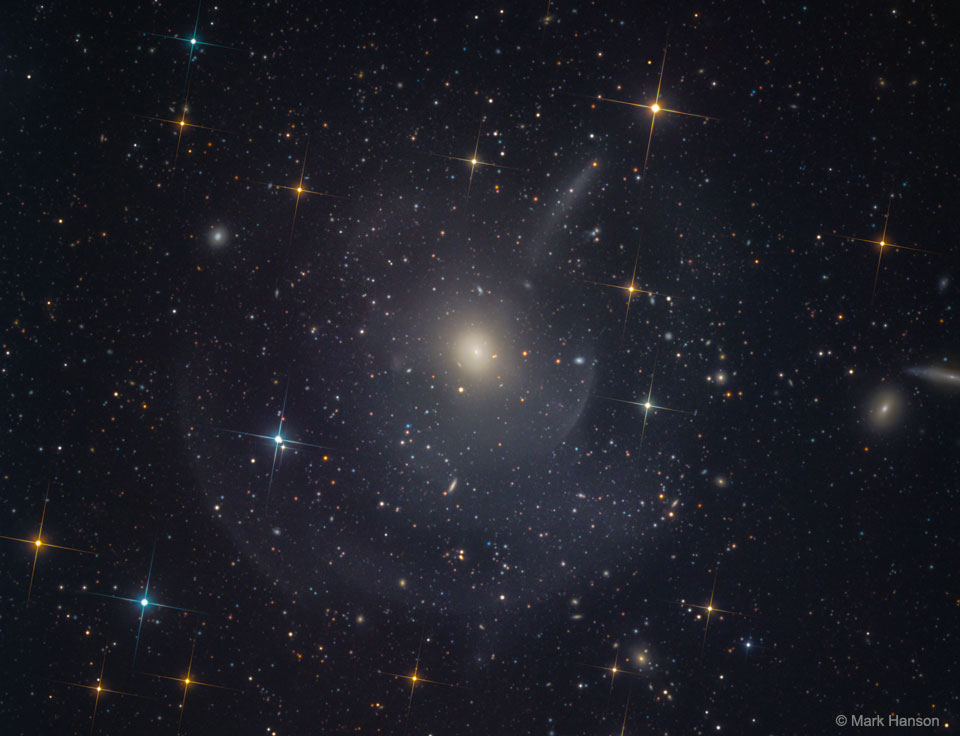
M89: Elliptical Galaxy with Outer Shells and Plumes


Can you see them? This famous Messier object M89, a seemingly simple elliptical galaxy, is surrounded by faint shells and plumes. The cause of the shells is currently unknown, but possibly tidal tails related to debris left over from absorbing numerous small galaxies in the past billion years. Alternatively the shells may be like ripples in a pond, where a recent collision with another large galaxy created density waves that ripple through this galactic giant. Regardless of the actual cause, the featured image highlights the increasing consensus that at least some elliptical galaxies have formed in the recent past, and that the outer halos of most large galaxies are not really smooth but have complexities induced by frequent interactions with -- and accretions of -- smaller nearby galaxies. The halo of our own Milky Way Galaxy is one example of such unexpected complexity. M89 is a member of the nearby Virgo cluster of galaxies which lies about 50 million light years distant. via NASA http://ift.tt/2smPVUD

Sunday, June 11, 2017

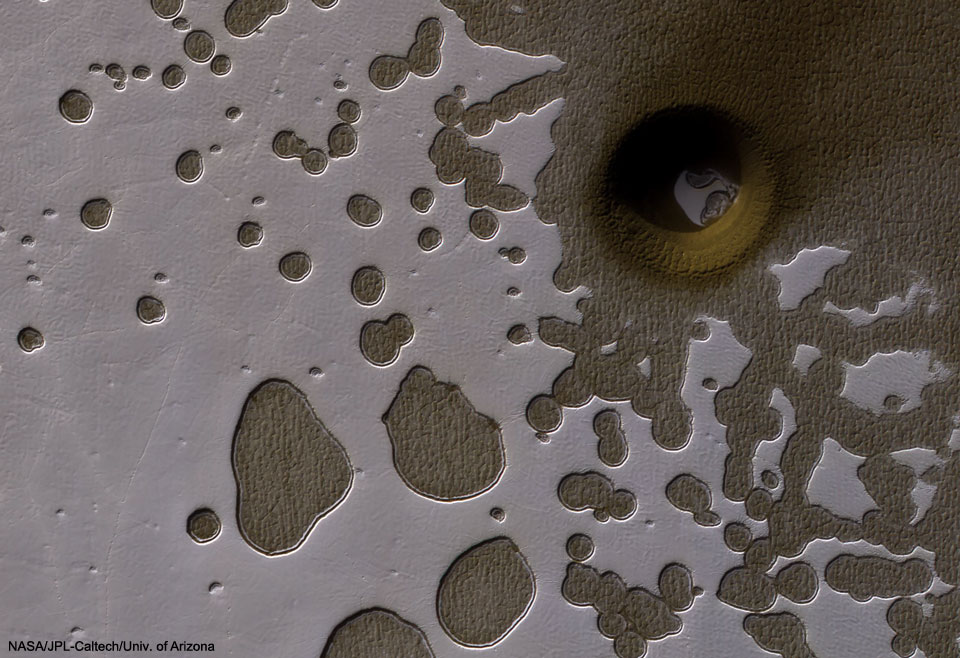
An Unusual Hole in Mars


What created this unusual hole in Mars? Actually, there are numerous holes pictured in this Swiss cheese-like landscape, with all-but-one of them showing a dusty, dark, Martian terrain beneath evaporating, light, carbon-dioxide ice. The most unusual hole is on the upper right, spans about 100-meters, and seems to punch through to a lower level. Why this hole exists and why it is surrounded by a circular crater remains a topic of speculation, although a leading hypothesis is that it was created by a meteor impact. Holes such as this are of particular interest because they might be portals to lower levels that extend into expansive underground caves. If so, these naturally-occurring tunnels are relatively protected from the harsh surface of Mars, making them relatively good candidates to contain Martian life. These pits are therefore prime targets for possible future spacecraft, robots, and even human interplanetary explorers. via NASA http://ift.tt/2rYV6qA

Friday, June 9, 2017

Saturn in the Milky Way


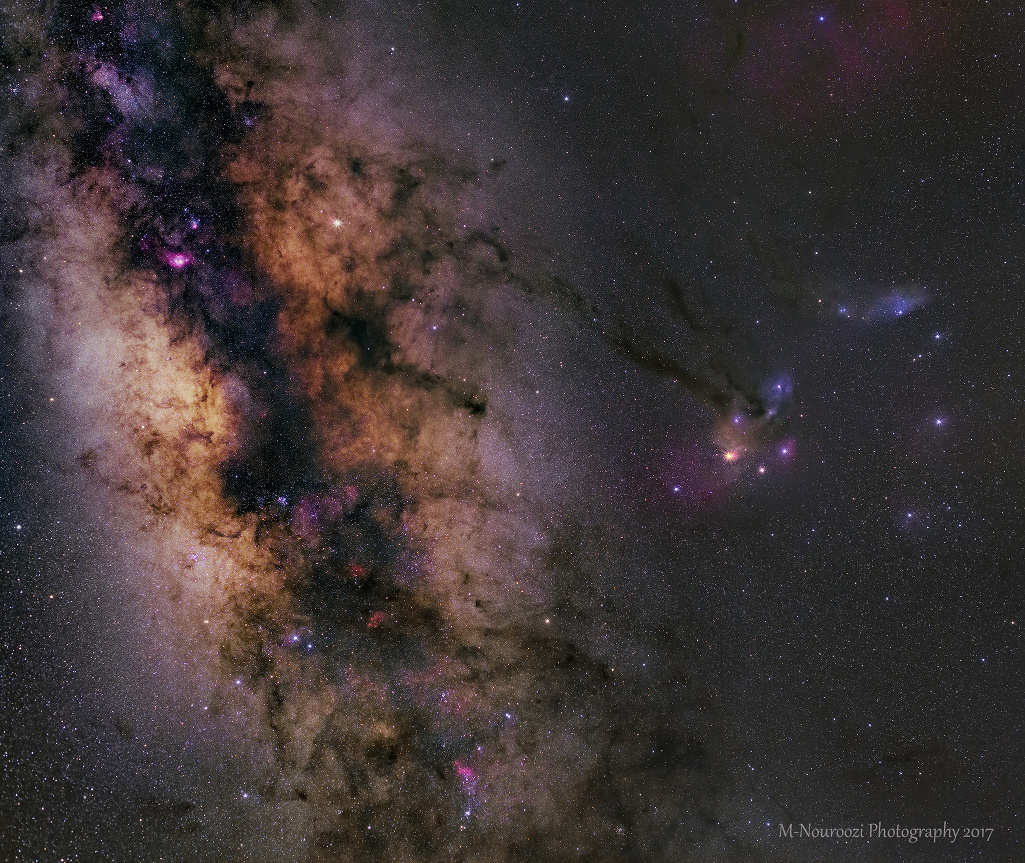
Saturn is near opposition in planet Earth's sky. Rising at sunset and shining brightly throughout the night, it also lies near a line-of-sight to crowded starfields, nebulae, and obscuring dust clouds along the Milky Way. Whitish Saturn is up and left of center in this gorgeous central Milky Way skyscape, a two panel mosaic recorded earlier this month. You can find the bright planet above the bowl of the dusty Pipe nebula, and just beyond the end of a dark river to Antares, alpha star of the constellation Scorpius. For now the best views of the ringed giant planet are from the Saturn-orbiting Cassini spacecraft, though. Diving close, Cassini's Grand Finale orbit number 8 is in progress. via NASA http://ift.tt/2sJ7ECt

Tuesday, June 6, 2017

The Case of the Missing Star


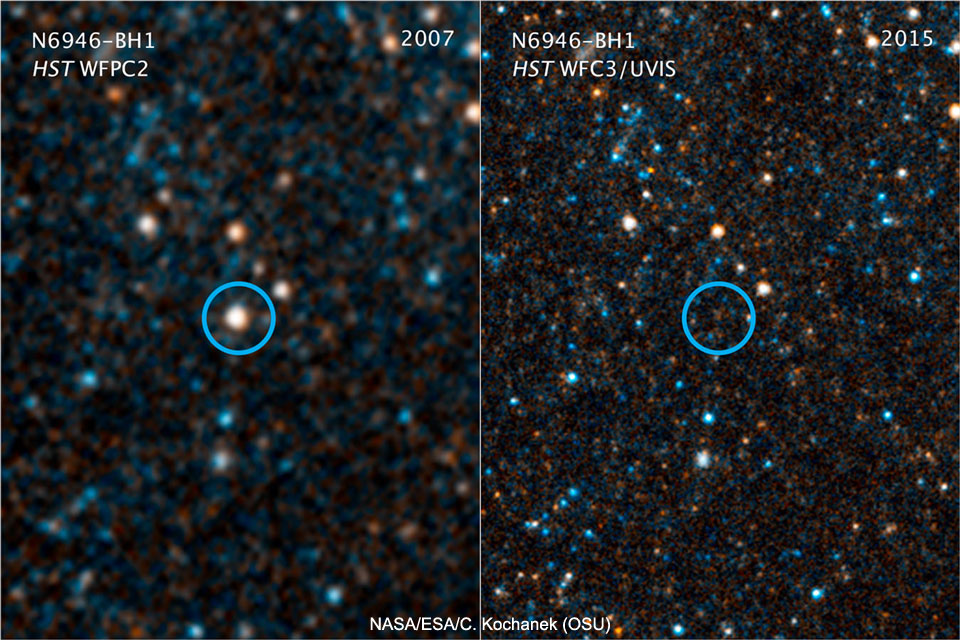
What's happened to giant star N6946-BH1? It was there just a few years ago -- Hubble imaged it. Now there's only a faint glow. What's curiouser, no bright supernova occurred -- although the star did brightened significantly for a few months. The leading theory is that, at about 25 times the mass of our Sun, N6946-BH1's great gravity held much of the star together during its final tumultuous death throes, after which most the star sunk into a black hole of its own making. If so, then what remained outside of the black hole likely then formed an accretion disk that emits comparatively faint infrared light as it swirls around, before falling in. If this mode of star death is confirmed with other stars, it gives direct evidence that a very massive star can end its life with a whimper rather than a bang. via NASA http://ift.tt/2rCQc2l

Sunday, June 4, 2017

Highlights of the Summer Sky


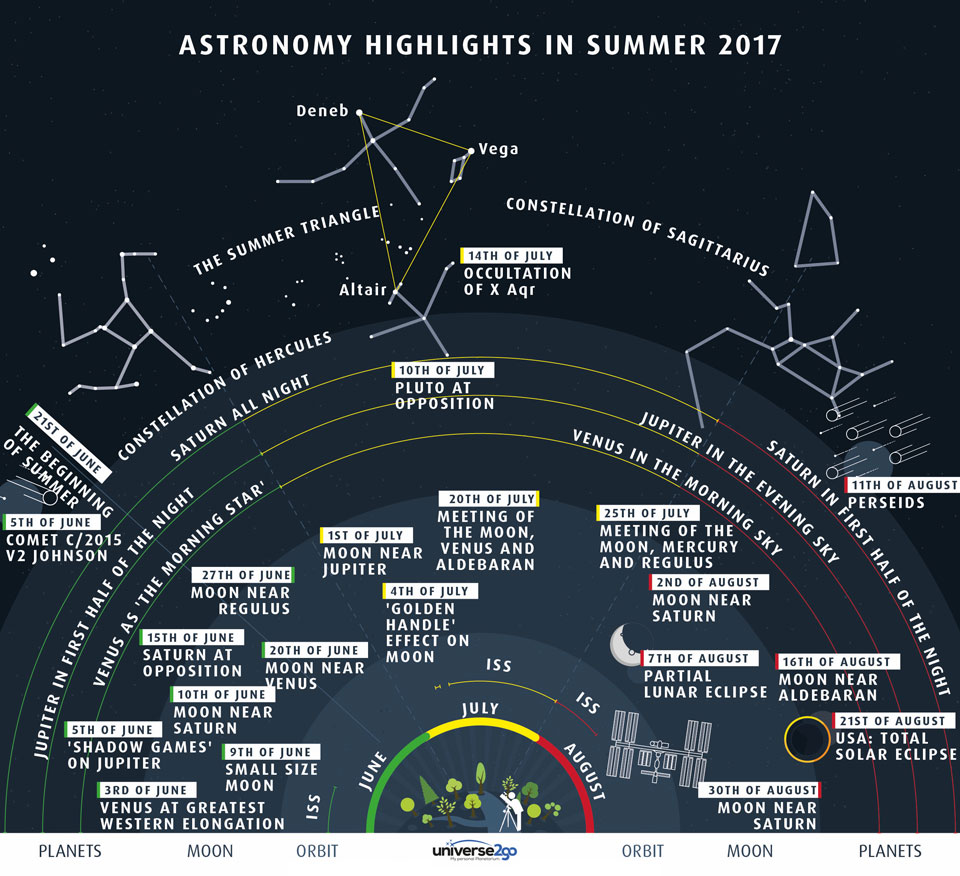
What's up in the sky this summer? The featured graphic gives a few highlights for Earth's northern hemisphere. Viewed as a clock face centered at the bottom, early summer sky events fan out toward the left, while late summer events are projected toward the right. Objects relatively close to Earth are illustrated, in general, as nearer to the cartoon figure with the telescope at the bottom center -- although almost everything pictured can be seen without a telescope. Highlights of this summer's sky include that Jupiter will be visible after sunset during June, while Saturn will be visible after sunset during August. A close grouping of the Moon, Venus and the bright star Aldebaran will occur during mid-July. In early August, the Perseids meteor shower peaks. Surely the most famous pending astronomical event occurring this summer, though, will be a total eclipse of the Sun visible over a thin cloud-free swath across the USA on 21 August. via NASA http://ift.tt/2srBATl

Friday, June 2, 2017

Perijove Passage


On May 19, the Juno spacecraft once again swung by Jupiter in its looping 53 day orbit around the Solar System's ruling gas gaint. Beginning at the top, this vertical 14 frame sequence of enhanced-color JunoCam images follows the spacecraft's rapidly changing perspective during its two hour passage. They look down on Jupiter's north polar region, equatorial, and south polar region (bottom images). With the field-of-view shrinking, the seventh and eighth images in the sequence are close-up. Taken only 4 minutes apart above Jupiter's equator they were captured just before the spacecraft reached perijove 6, its closest approach to Jupiter on this orbit. Final images in the sequence pick up white oval storm systems, Jupiter's "String of Pearls", and the south polar region from the outward bound spacecraft. via NASA http://ift.tt/2rLehHf

Thursday, June 1, 2017

Black Holes of Known Mass


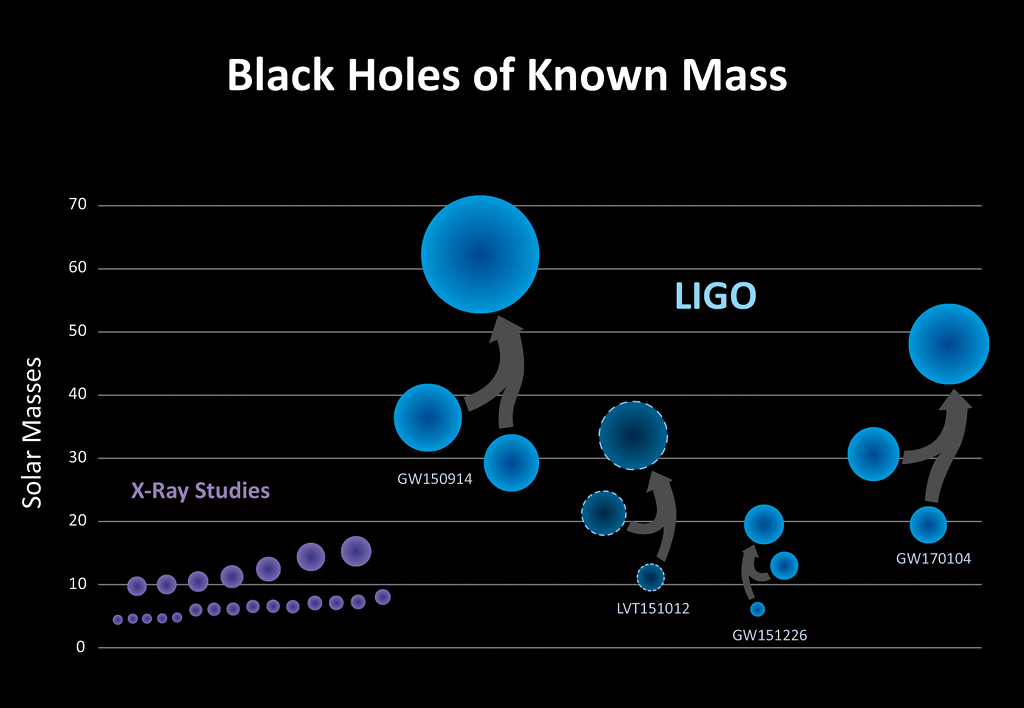
Add GW170104 to the chart of black holes with known mass. The extremely energetic merger of two smaller black holes corresponds to the Laser Interferometer Gravitational-wave Observatory's (LIGO) third detection of gravitational waves. The newfound black hole has a mass about 49 times that of the Sun, filling a gap between the masses of the two merged black holes detected previously by LIGO, with solar masses of 62 (GW150914) and 21 (GW151216). In all three cases, the signal in each of the twin LIGO detectors was unambiguously identified as coming from black hole mergers while a fourth case (LVT151012) resulted in a lower confidence detection. GW170104 is estimated to be some 3 billion light-years away, more distant than present estimates for GW150914 and GW151216. The ripples in spacetime were discovered during LIGO's current observing run, which began November 30, 2016 and will continue through the summer. via NASA http://ift.tt/2ron3b5