Wednesday, May 31, 2017

Shadowrise and Sunset


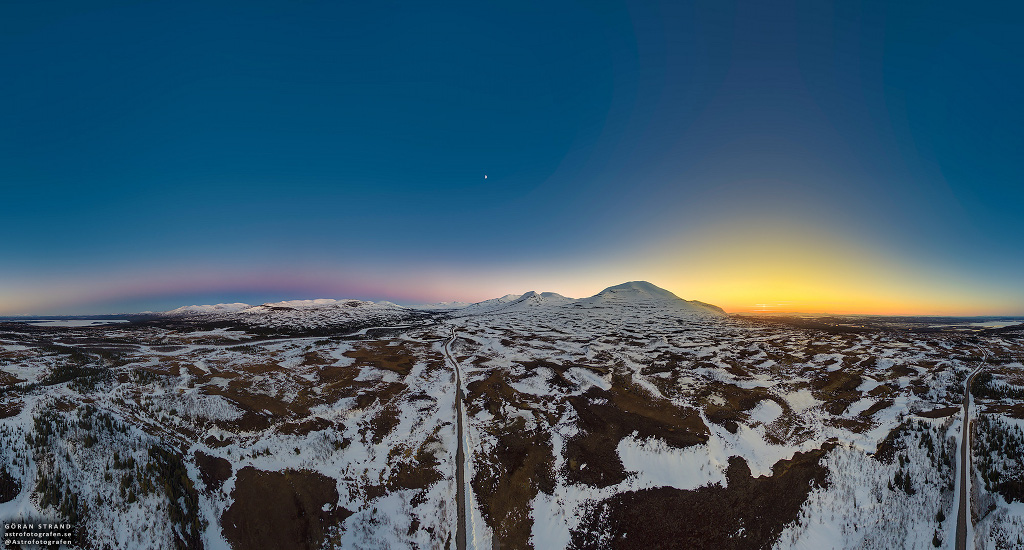
The road tracking through this stunning 360 degree view crosses a remote mountain area of Jämtland, Sweden, planet Earth. A 3x8 mosaic of still images, the panorama was taken on May 3rd from a small drone 200 meters above the ground. The scene records the warm light of the Sun setting in the northwest and the planet's dark shadow rising in the southeast. A small sun pillar gives away the Sun's position just below the horizon while the pinkish anti-twilight arch or belt of Venus outlines Earth's shadow. In the middle of the remarkably clear sky, the First Quarter Moon is visible above the mountains, its half illuminated disk separating sunset and shadowrise. A range of exposures were combined to cover the difference in sky brightness for sunset and Earth shadow. The tallest peak left of the sunset is Storsnasen, some 1400 meters above sea level. via NASA http://ift.tt/2smc7db

Sunday, May 28, 2017

Beneath Jupiter


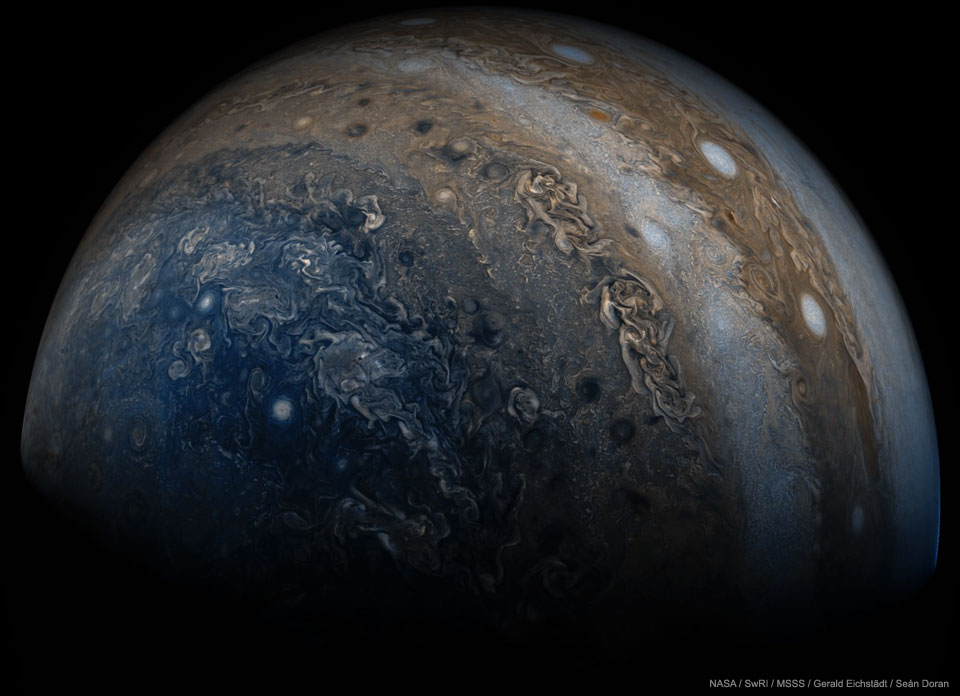
Jupiter is stranger than we knew. NASA's Juno spacecraft has now completed its sixth swoop past Jupiter as it moves around its highly elliptical orbit. Pictured, Jupiter is seen from below where, surprisingly, the horizontal bands that cover most of the planet disappear into swirls and complex patterns. A line of white oval clouds is visible nearer to the equator. Recent results from Juno show that Jupiter's weather phenomena can extend deep below its cloud tops, and that Jupiter's magnetic field varies greatly with location. Juno is scheduled to orbit Jupiter 37 times with each orbit taking about six weeks. via NASA http://ift.tt/2raF6n2

Thursday, May 25, 2017

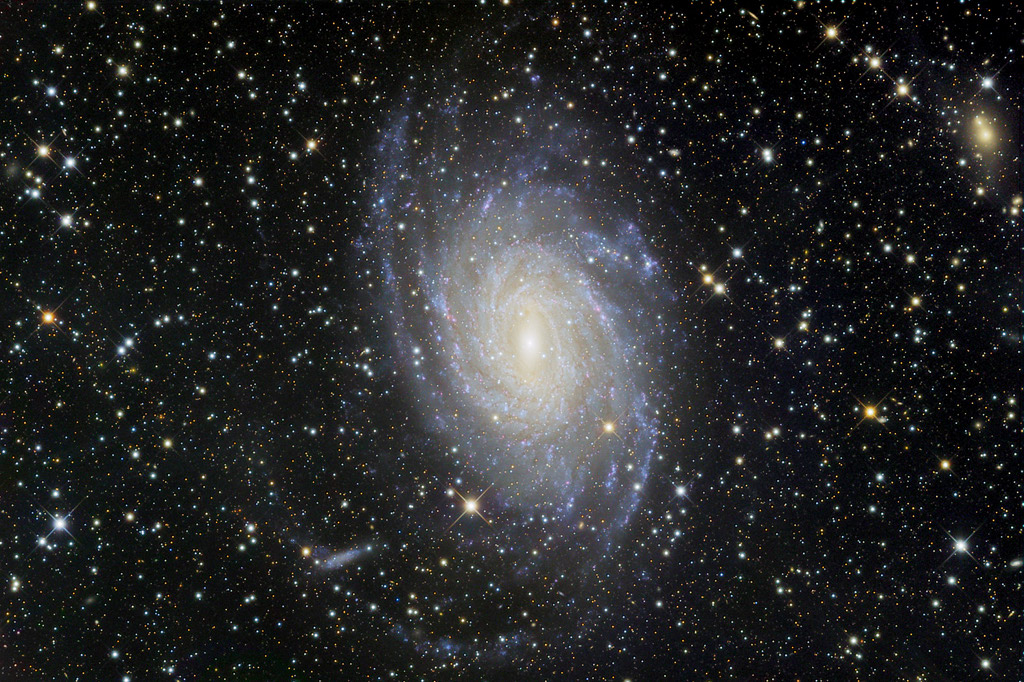
Spiral Galaxy NGC 6744


Big, beautiful spiral galaxy NGC 6744 is nearly 175,000 light-years across, larger than our own Milky Way. It lies some 30 million light-years distant in the southern constellation Pavo appearing as a faint, extended object in small telescopes. We see the disk of the nearby island universe tilted towards our line of sight. This remarkably distinct and detailed galaxy portrait covers an area about the angular size of the full moon. In it, the giant galaxy's yellowish core is dominated by the light from old, cool stars. Beyond the core, spiral arms filled with young blue star clusters and pinkish star forming regions sweep past a smaller satellite galaxy at the lower left, reminiscent of the Milky Way's satellite galaxy the Large Magellanic Cloud. via NASA http://ift.tt/2rYmkwq

Tuesday, May 23, 2017

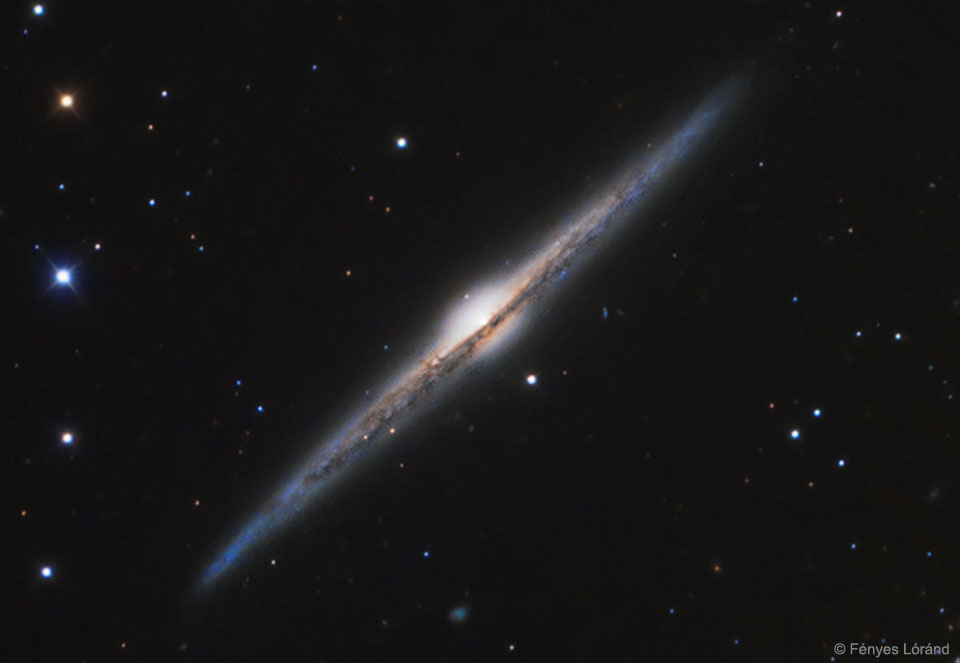
NGC 4565: Galaxy on Edge


Is our Galaxy this thin? We believe so. Magnificent spiral galaxy NGC 4565 is viewed edge-on from planet Earth. Also known as the Needle Galaxy for its narrow profile, bright NGC 4565 is a stop on many telescopic tours of the northern sky, in the faint but well-groomed constellation Coma Berenices. This sharp, colorful image reveals the galaxy's bulging central core cut by obscuring dust lanes that lace NGC 4565's thin galactic plane. An assortment of other background galaxies is included in the pretty field of view, with neighboring galaxy NGC 4562 at the upper left. NGC 4565 itself lies about 40 million light-years distant and spans some 100,000 light-years. Easily spotted with small telescopes, sky enthusiasts consider NGC 4565 to be a prominent celestial masterpiece Messier missed. via NASA http://ift.tt/2qS4ZWw

Sunday, May 21, 2017

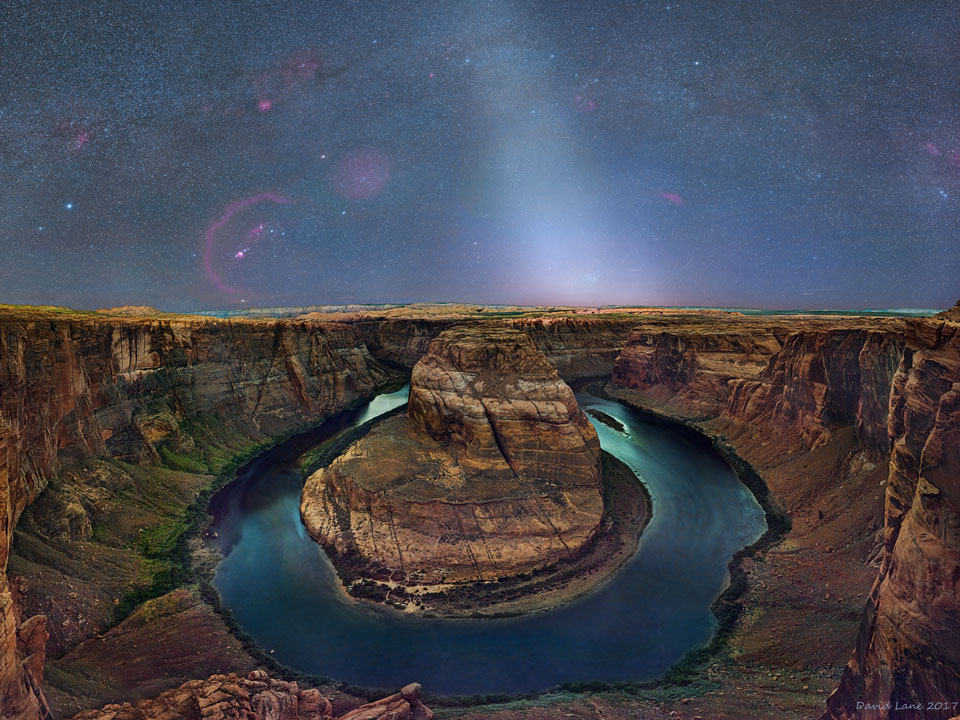
A Zodiacal Sky over Horseshoe Bend


What's causing the unusual ray of white light extending upward from the central horizon? Dust orbiting the Sun. At certain times of the year, a band of sun-reflecting dust from the inner Solar System rises prominently before sunrise and is called zodiacal light. The dust originates mostly from faint Jupiter-family comets and slowly spirals into the Sun. Pictured, in front of the zodiacal light, is a spectacular view of Horseshoe Bend of the Colorado River. Emitted from well behind the zodiacal light is a spectacular sky that includes many bright stars including Sirius, several blue star clusters including the Pleiades, and an assortment of red nebula including Barnard's Loop in Orion. The 30-image composite was taken earlier this month in nearly complete darkness only six inches from the edge of a dangerous cliff. via NASA http://ift.tt/2qEbjmb

Saturday, May 20, 2017

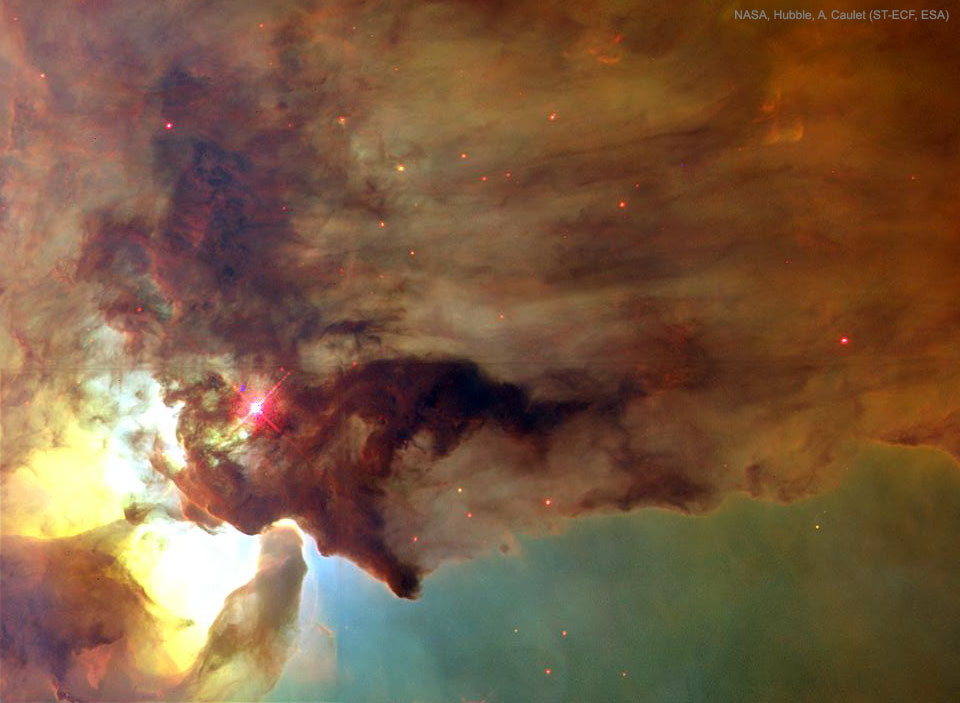
In the Center of the Lagoon Nebula


The center of the Lagoon Nebula is a whirlwind of spectacular star formation. Visible on the lower left, at least two long funnel-shaped clouds, each roughly half a light-year long, have been formed by extreme stellar winds and intense energetic starlight. The tremendously bright nearby star, Hershel 36, lights the area. Vast walls of dust hide and redden other hot young stars. As energy from these stars pours into the cool dust and gas, large temperature differences in adjoining regions can be created generating shearing winds which may cause the funnels. This picture, spanning about 5 light years, was taken in 1995 by the orbiting Hubble Space Telescope. The Lagoon Nebula, also known as M8, lies about 5000 light years distant toward the constellation of Sagittarius. via NASA http://ift.tt/2q2XieY

Friday, May 19, 2017

A View Toward M101


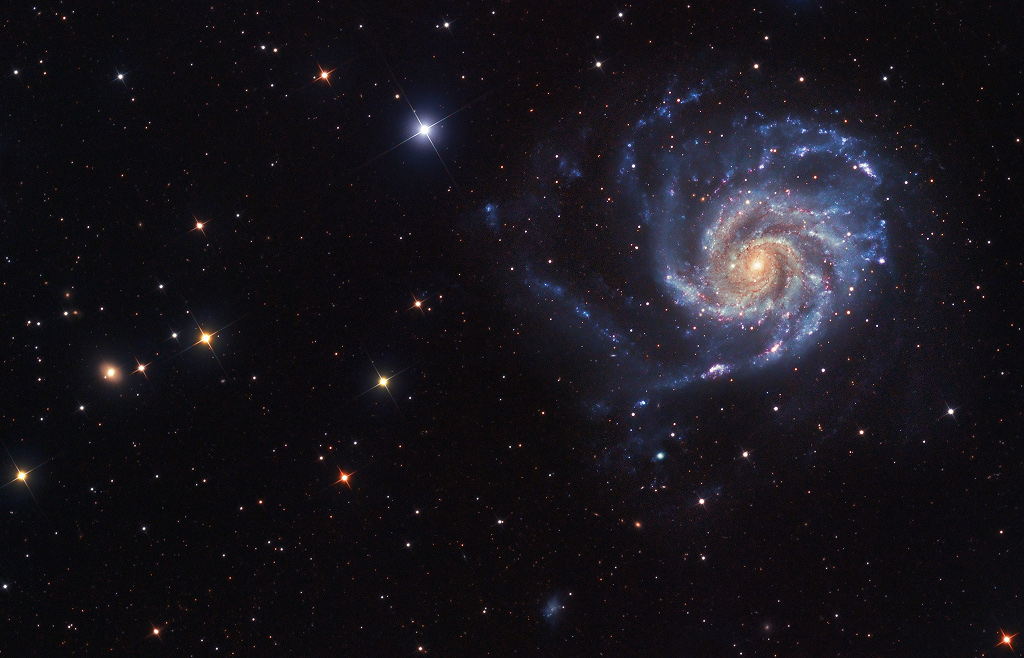
Big, beautiful spiral galaxy M101 is one of the last entries in Charles Messier's famous catalog, but definitely not one of the least. About 170,000 light-years across, this galaxy is enormous, almost twice the size of our own Milky Way galaxy. M101 was also one of the original spiral nebulae observed by Lord Rosse's large 19th century telescope, the Leviathan of Parsontown. M101 shares this modern telescopic field of view with spiky foreground stars within the Milky Way, and more distant background galaxies. The colors of the Milky Way stars can also be found in the starlight from the large island universe. Its core is dominated by light from cool yellowish stars. Along its grand spiral arms are the blue colors of hotter, young stars mixed with obscuring dust lanes and pinkish star forming regions. Also known as the Pinwheel Galaxy, M101 lies within the boundaries of the northern constellation Ursa Major, about 25 million light-years away. via NASA http://ift.tt/2q2xsqy