Thursday, May 18, 2017

Wolf Lundmark Melotte


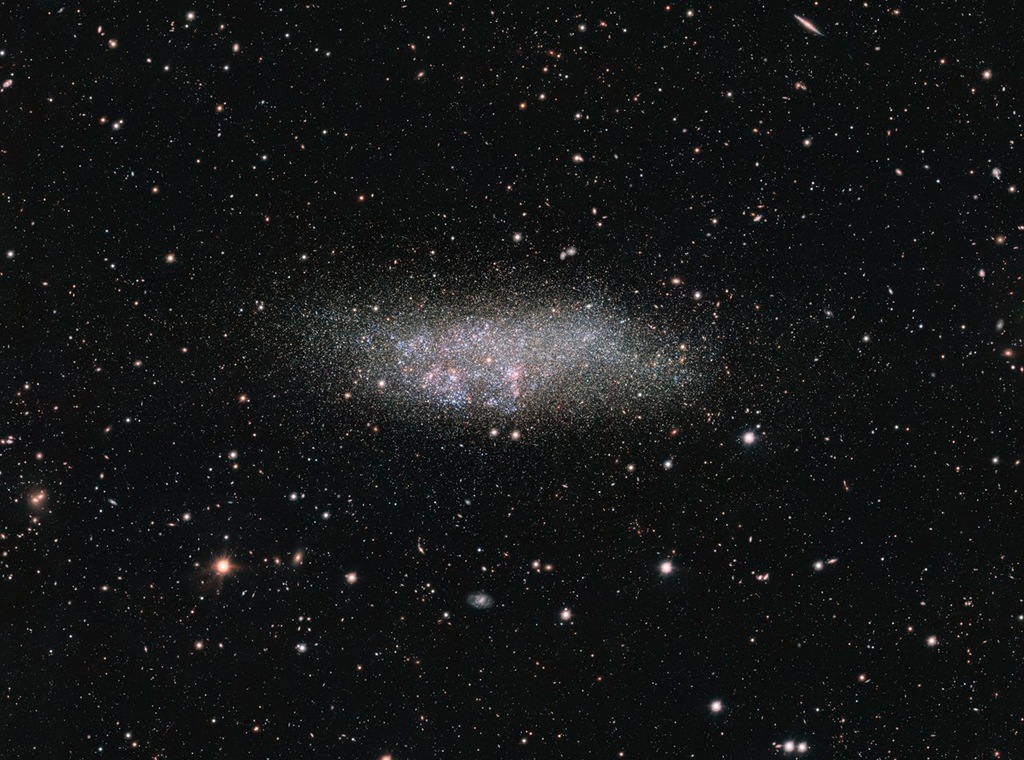
Named for the three astronomers instrumental in its discovery and identification, Wolf - Lundmark - Melotte (WLM) is a lonely dwarf galaxy. Seen toward the mostly southern constellation Cetus, about 3 million light-years from the Milky Way, it is one of the most remote members of our local galaxy group. In fact, it may never have interacted with any other local group galaxy. Still, telltale pinkish star forming regions and hot, young, bluish stars speckle the isolated island universe. Older, cool yellowish stars fade into the small galaxy's halo, extending about 8,000 light-years across. This sharp portrait of WLM was captured by the 268-megapixel OmegaCAM widefield imager and survey telescope at ESO's Paranal Observatory. via NASA http://ift.tt/2qUdrHO

Wednesday, May 17, 2017

Simeis 147: Supernova Remnant


It's easy to get lost following intricate filaments in this detailed image of faint supernova remnant Simeis 147. Also cataloged as Sharpless 2-240 it goes by the popular nickname, the Spaghetti Nebula. Seen toward the boundary of the constellations Taurus and Auriga, it covers nearly 3 degrees or 6 full moons on the sky. That's about 150 light-years at the stellar debris cloud's estimated distance of 3,000 light-years. This composite includes image data taken through narrow-band filters, enhancing the reddish emission from ionized hydrogen atoms to trace the shocked, glowing gas. The supernova remnant has an estimated age of about 40,000 years, meaning light from the massive stellar explosion first reached Earth 40,000 years ago. But the expanding remnant is not the only aftermath. The cosmic catastrophe also left behind a spinning neutron star or pulsar, all that remains of the original star's core. via NASA http://ift.tt/2pTVp45

Tuesday, May 16, 2017

Galaxy Group Hickson 90


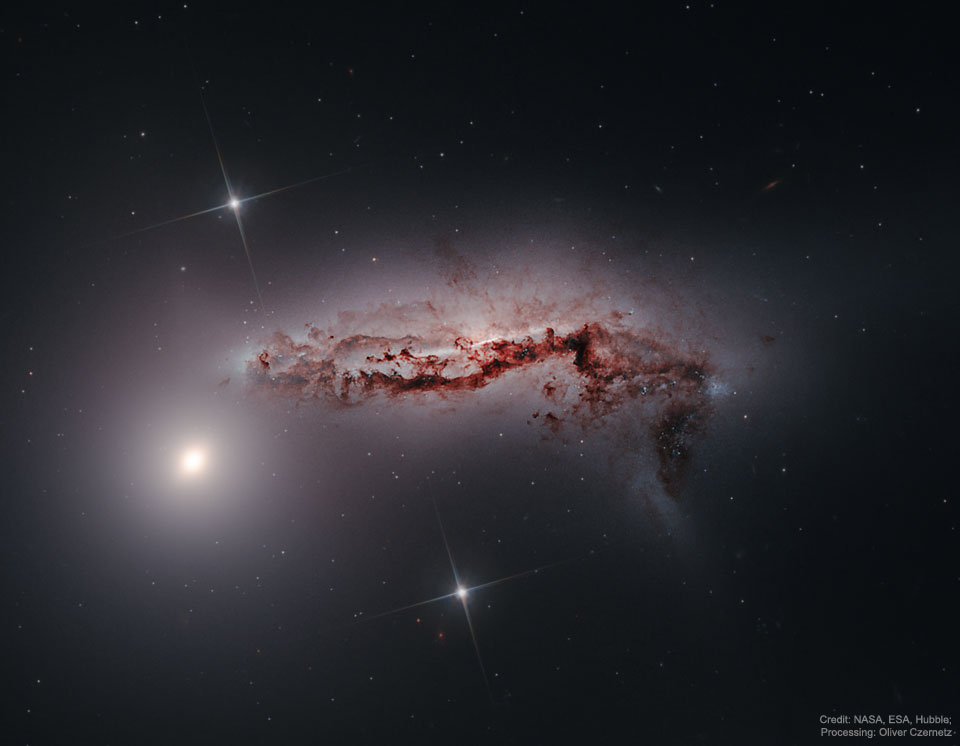
Scanning the skies for galaxies, Canadian astronomer Paul Hickson and colleagues identified some 100 compact groups of galaxies, now appropriately called Hickson Compact Groups (HCGs). This sharp Hubble image shows one such galaxy group, HCG 90, in startling detail. Three galaxies -- two visible here -- are revealed to be strongly interacting: a dusty spiral galaxy stretched and distorted in the image center, and two large elliptical galaxies. The close encounter will trigger furious star formation. On a cosmic timescale, the gravitational tug of war will eventually result in the merger of the trio into a large single galaxy. The merger process is now understood to be a normal part of the evolution of galaxies, including our own Milky Way. HCG 90 lies about 100 million light-years away toward the constellation of the Southern Fish (Piscis Austrinus). This Hubble view spans about 40,000 light-years at that estimated distance. Of course, Hickson Compact Groups also make for rewarding viewing for Earth-bound astronomers with more modest sized telescopes. via NASA http://ift.tt/2rktieV

Monday, May 15, 2017

Gemini Stars Pollux and Castor


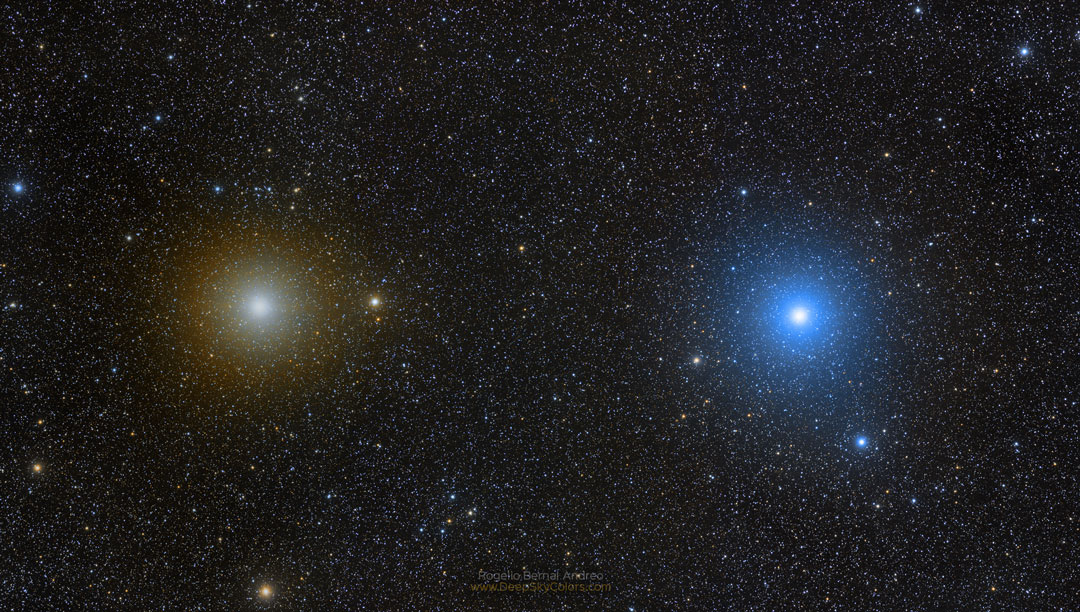
Who are the twins of Gemini? It terms of astronomical objects, the famous constellation is dominated by two bright stars: Pollux (left) and Castor (right). Pictured, the two stars stand out because they are so bright, so close together both in angle and brightness, but so different in color. Pollux, at 33 light years distant, is an evolved red giant star twice as massive as our Sun. Castor, at 51 light years distant, is a blue main sequence star about 2.7 times more massive that our Sun. Castor is known to have at least two stellar companions, while Pollux is now known to be circled by at least one massive planet. In terms of ancient Babylonian, Greek, and Roman mythology, Castor and Pollux represent twin brothers. Currently, the Earth's orbit is causing the Sun to appear to shift in front of the constellation of Gemini, with the result that, for much of humanity, Castor and Pollux will remain visible toward the west at sunset for only a few more weeks. via NASA http://ift.tt/2pPdkck

Saturday, May 13, 2017

Ganymede: The Largest Moon


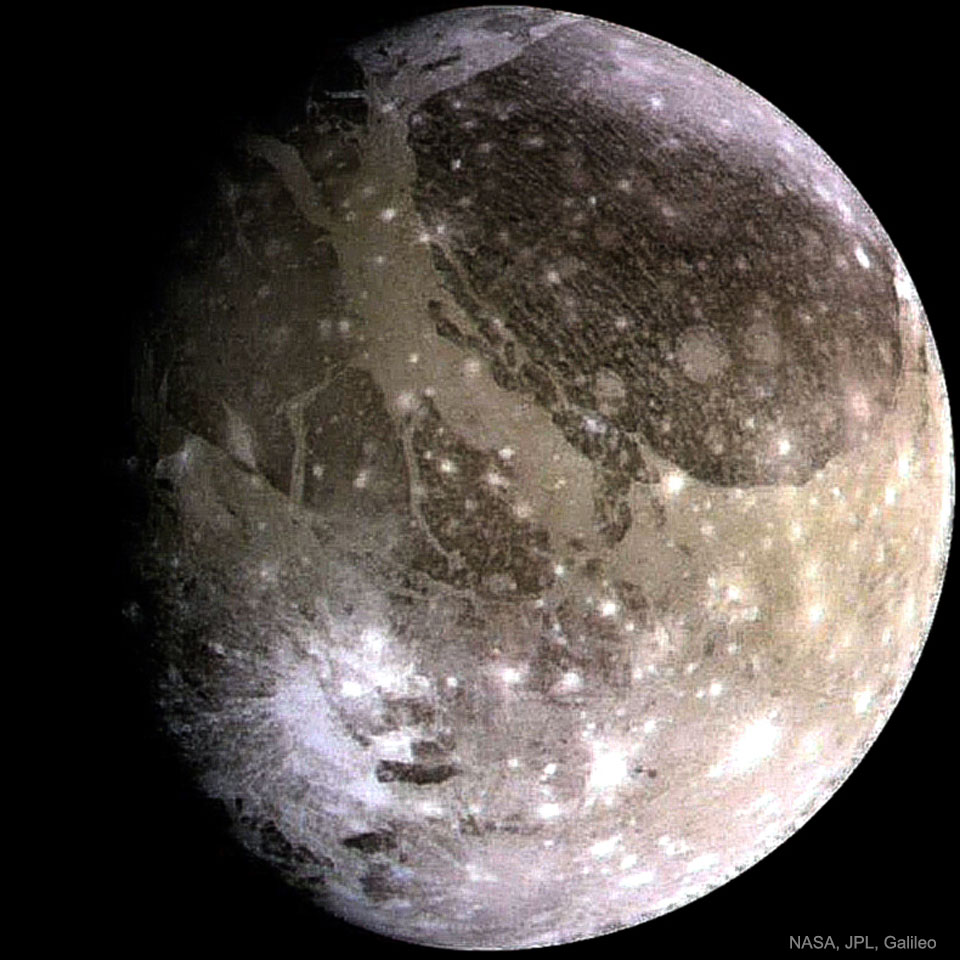
What does the largest moon in the Solar System look like? Jupiter's moon Ganymede, larger than even Mercury and Pluto, has an icy surface speckled with bright young craters overlying a mixture of older, darker, more cratered terrain laced with grooves and ridges. The large circular feature on the upper right, called Galileo Regio, is an ancient region of unknown origin. Ganymede is thought to have an ocean layer that contains more water than Earth and might contain life. Like Earth's Moon, Ganymede keeps the same face towards its central planet, in this case Jupiter. The featured image was taken about 20 years ago by NASA's Galileo probe, which ended its mission by diving into Jupiter's atmosphere in 2003. Currently, NASA's Juno spacecraft orbits Jupiter and is studying the giant planet's internal structure, among many other attributes. via NASA http://ift.tt/2purljG

Thursday, May 11, 2017

M13: The Great Globular Cluster in Hercules


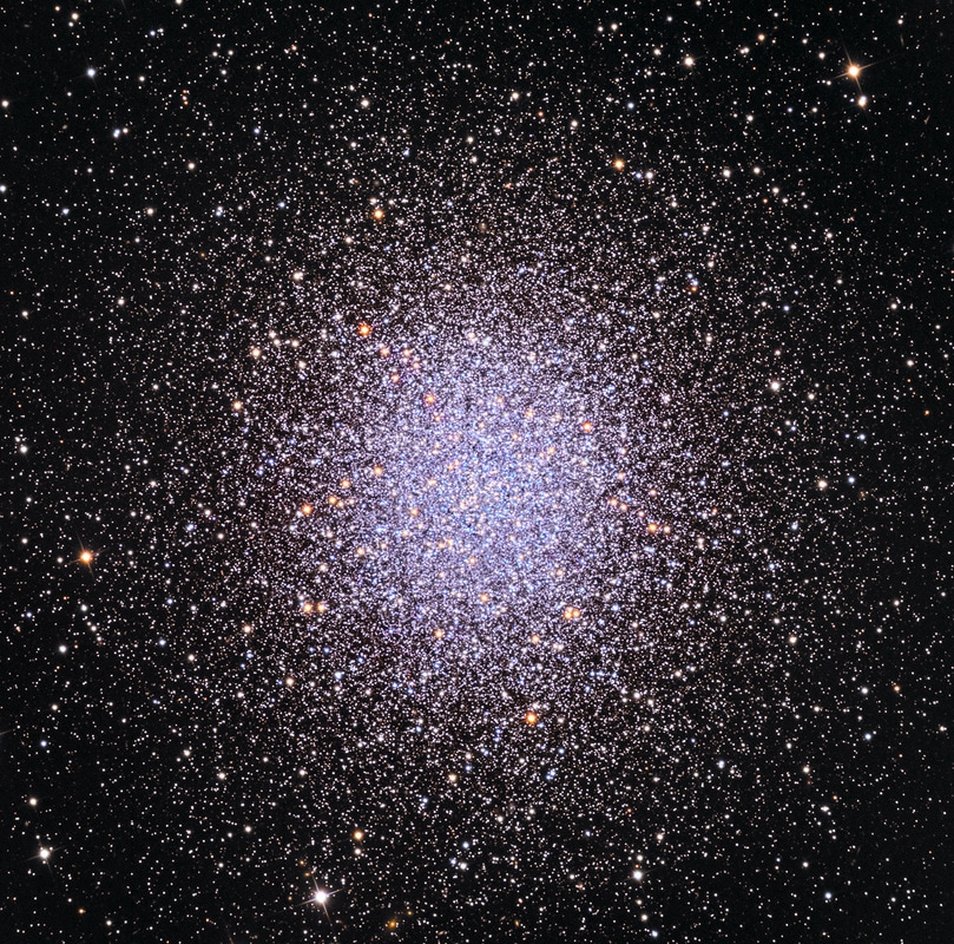
In 1716, English astronomer Edmond Halley noted, "This is but a little Patch, but it shews itself to the naked Eye, when the Sky is serene and the Moon absent." Of course, M13 is now less modestly recognized as the Great Globular Cluster in Hercules, one of the brightest globular star clusters in the northern sky. Telescopic views reveal the spectacular cluster's hundreds of thousands of stars. At a distance of 25,000 light-years, the cluster stars crowd into a region 150 light-years in diameter. Approaching the cluster core upwards of 100 stars could be contained in a cube just 3 light-years on a side. For comparison, the closest star to the Sun is over 4 light-years away. Along with the cluster's dense core, the outer reaches of M13 are highlighted in this sharp color image. The cluster's evolved red and blue giant stars show up in yellowish and blue tints. via NASA http://ift.tt/2qVE9iG

Wednesday, May 10, 2017

The Multiwavelength Crab


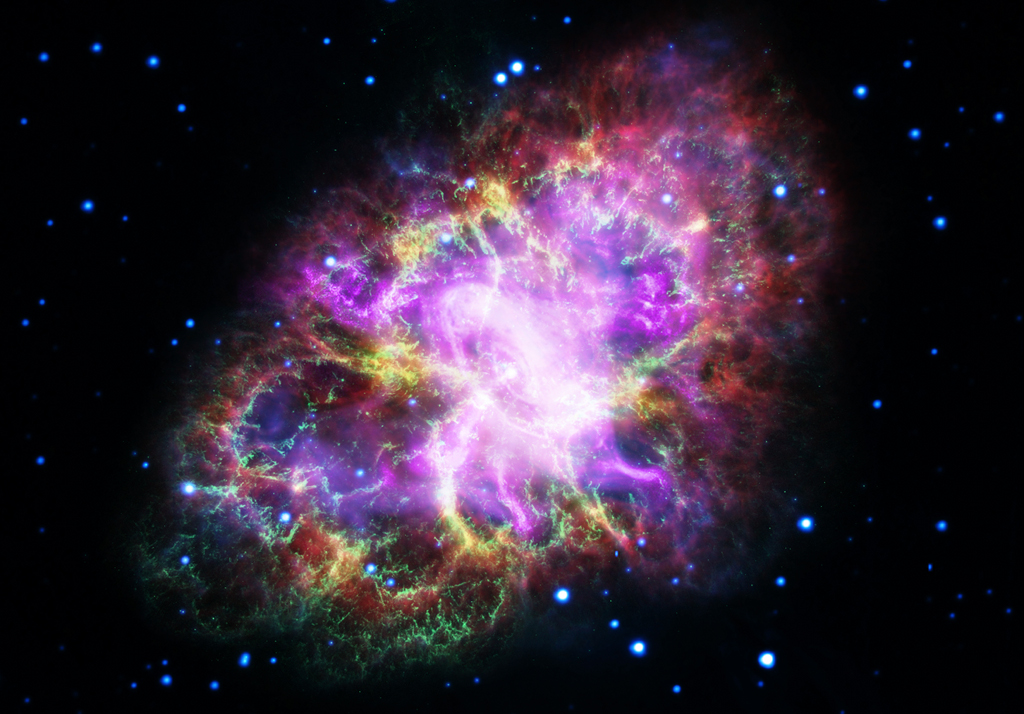
The Crab Nebula is cataloged as M1, the first object on Charles Messier's famous list of things which are not comets. In fact, the Crab is now known to be a supernova remnant, expanding debris from massive star's death explosion, witnessed on planet Earth in 1054 AD. This brave new image offers a 21st century view of the Crab Nebula by presenting image data from across the electromagnetic spectrum as wavelengths of visible light. From space, Chandra (X-ray) XMM-Newton (ultraviolet), Hubble (visible), and Spitzer (infrared), data are in purple, blue, green, and yellow hues. From the ground, Very Large Array radio wavelength data is in shown in red. One of the most exotic objects known to modern astronomers, the Crab Pulsar, a neutron star spinning 30 times a second, is the bright spot near picture center. Like a cosmic dynamo, this collapsed remnant of the stellar core powers the Crab's emission across the electromagnetic spectrum. Spanning about 12 light-years, the Crab Nebula is 6,500 light-years away in the constellation Taurus. via NASA http://ift.tt/2r0edjf