This group is popular in the northern spring. Famous as the Leo Triplet, the three magnificent galaxies gather in one field of view. Crowd pleasers when imaged with even modest telescopes, they can be introduced individually as NGC 3628 (left), M66 (bottom right), and M65 (top). All three are large spiral galaxies but they tend to look dissimilar because their galactic disks are tilted at different angles to our line of sight. NGC 3628 is seen edge-on, with obscuring dust lanes cutting across the plane of the galaxy, while the disks of M66 and M65 are both inclined enough to show off their spiral structure. Gravitational interactions between galaxies in the group have also left telltale signs, including the warped and inflated disk of NGC 3628 and the drawn out spiral arms of M66. This gorgeous view of the region spans about one degree (two full moons) on the sky. The field covers over 500 thousand light-years at the trio's estimated distance of 30 million light-years. via NASA http://ift.tt/2p3iAJs
Tuesday, April 11, 2017
Friday, April 7, 2017
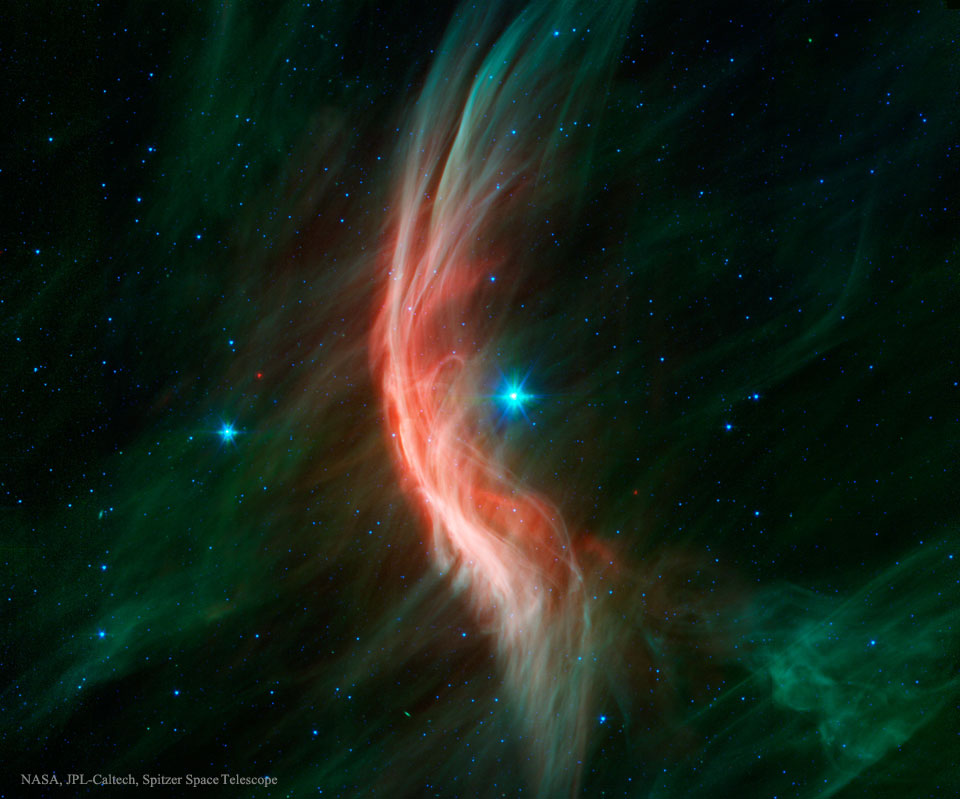
Zeta Oph: Runaway Star

Like a ship plowing through cosmic seas, runaway star Zeta Ophiuchi produces the arcing interstellar bow wave or bow shock seen in this stunning infrared portrait. In the false-color view, bluish Zeta Oph, a star about 20 times more massive than the Sun, lies near the center of the frame, moving toward the left at 24 kilometers per second. Its strong stellar wind precedes it, compressing and heating the dusty interstellar material and shaping the curved shock front. What set this star in motion? Zeta Oph was likely once a member of a binary star system, its companion star was more massive and hence shorter lived. When the companion exploded as a supernova catastrophically losing mass, Zeta Oph was flung out of the system. About 460 light-years away, Zeta Oph is 65,000 times more luminous than the Sun and would be one of the brighter stars in the sky if it weren't surrounded by obscuring dust. The image spans about 1.5 degrees or 12 light-years at the estimated distance of Zeta Ophiuchi. via NASA http://ift.tt/2o860IV
Thursday, April 6, 2017
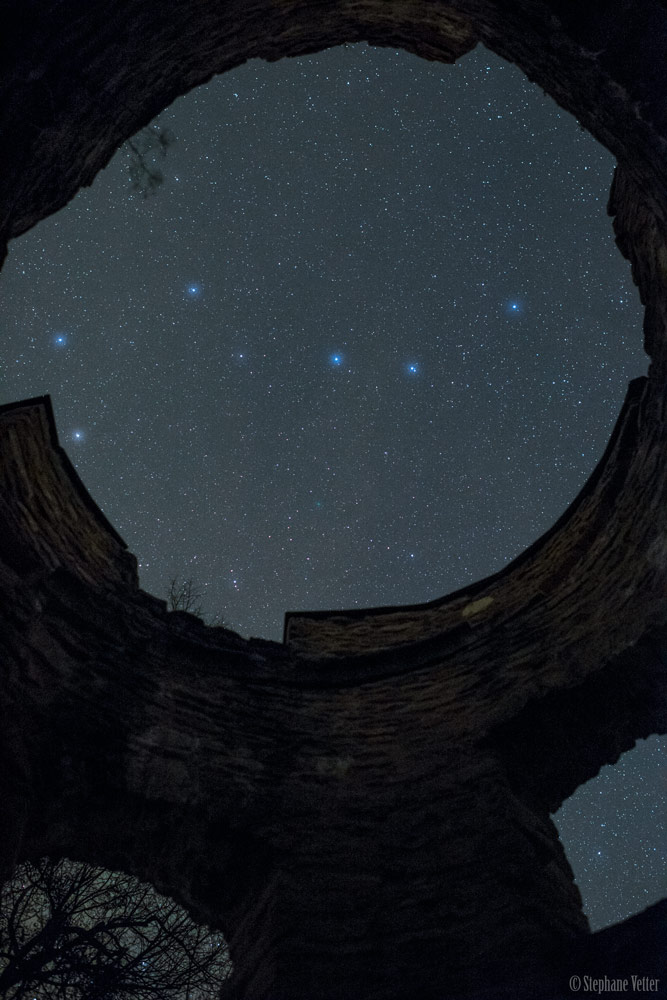
Castle Eye View

The best known asterism in northern skies, The Big Dipper is easy to recognize, even when viewed upside down, though some might see a plough or wagon. The star names and the familiar outlines appear framed in the ruined tower walls of the French Chateau du Morimont if you just slide your cursor over the image or follow this link. Dubhe, alpha star of the dipper's parent constellation Ursa Major is at the lower left. Together with beta star Merak the two form a line pointing the way to Polaris and the North Celestial Pole, hidden from view by the stones. Since the image was captured on March 30, you can follow a line from dipper stars Phecda and Megrez to spot the faint greenish glow of Comet 41P/Tuttle-Giacobini-Kresak below center, still within the castle eye view. The periodic comet made a remarkable close approach to planet Earth on April 1. via NASA http://ift.tt/2oFThzz
Sunday, April 2, 2017
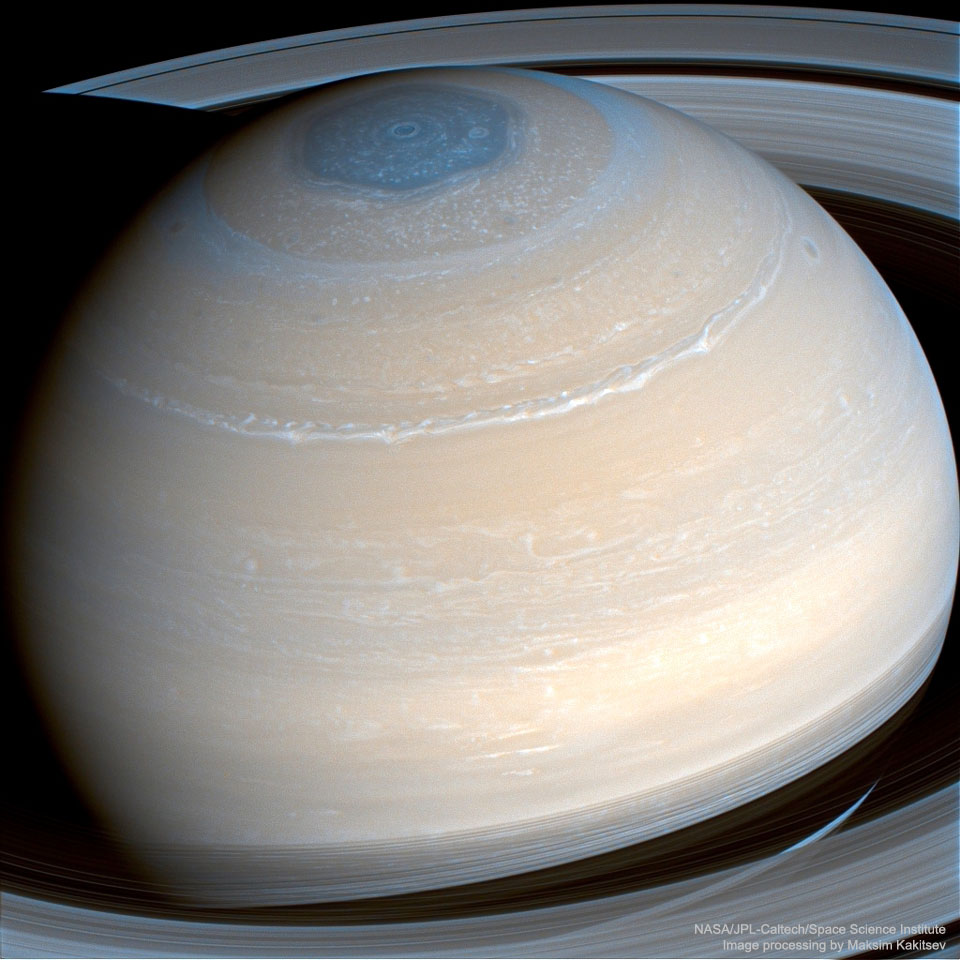
Saturn in Infrared from Cassini

Many details of Saturn appear clearly in infrared light. Bands of clouds show great structure, including long stretching storms. Also quite striking in infrared is the unusual hexagonal cloud pattern surrounding Saturn's North Pole. Each side of the dark hexagon spans roughly the width of our Earth. The hexagon's existence was not predicted, and its origin and likely stability remains a topic of research. Saturn's famous rings circle the planet and cast shadows below the equator. The featured image was taken by the robotic Cassini spacecraft in 2014 in several infrared colors -- but only processed recently. In September, Cassini's mission will be brought to a dramatic conclusion as the spacecraft will be directed to dive into ringed giant. via NASA http://ift.tt/2nNU9AQ
Saturday, April 1, 2017
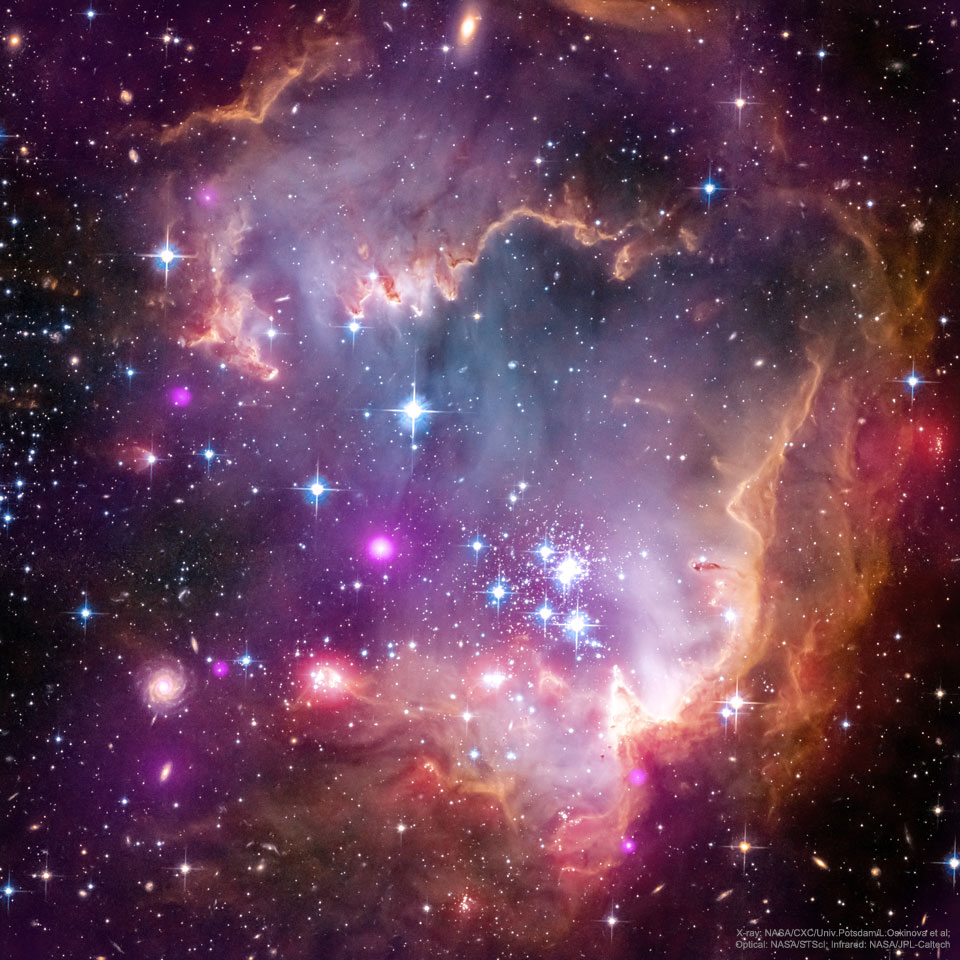
NGC 602 and Beyond

Near the outskirts of the Small Magellanic Cloud, a satellite galaxy some 200 thousand light-years distant, lies 5 million year young star cluster NGC 602. Surrounded by natal gas and dust, NGC 602 is featured in this stunning Hubble image of the region, augmented by images in the X-ray by Chandra, and in the infrared by Spitzer. Fantastic ridges and swept back shapes strongly suggest that energetic radiation and shock waves from NGC 602's massive young stars have eroded the dusty material and triggered a progression of star formation moving away from the cluster's center. At the estimated distance of the Small Magellanic Cloud, the Picture spans about 200 light-years, but a tantalizing assortment of background galaxies are also visible in this sharp multi-colored view. The background galaxies are hundreds of millions of light-years or more beyond NGC 602. via NASA http://ift.tt/2oKD0Ws
Friday, March 31, 2017
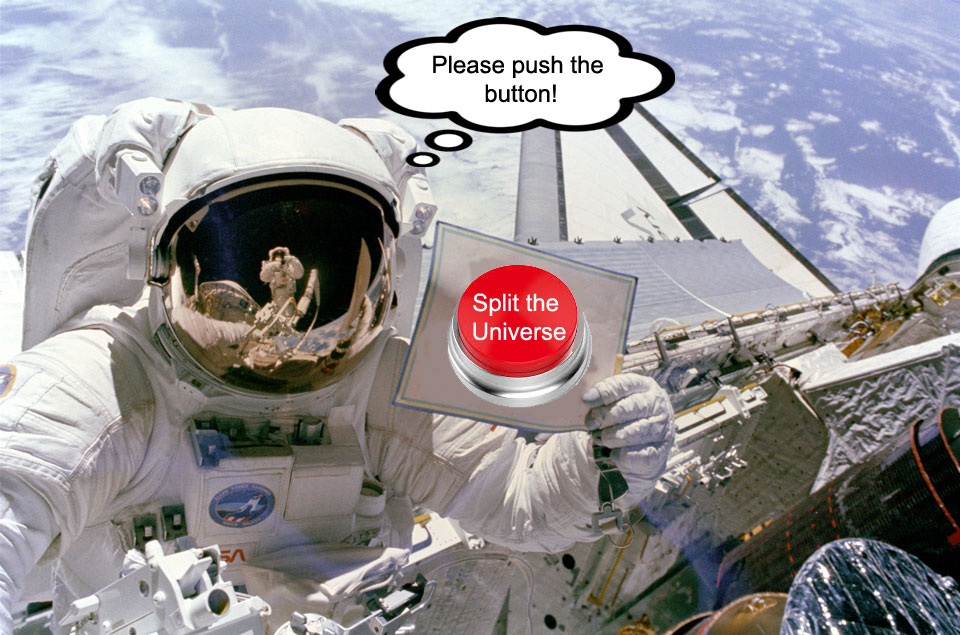
Split the Universe

Just now, before you hit the button, two future universes are possible. After pressing the button, though, you will live in only one. A real-web version of the famous Schrödinger's cat experiment, clicking the red button in the featured astronaut image should transform that image into a picture of the same astronaut holding one of two cats -- one living, or one dead. The timing of your click, combined with the wiring of your brain and the millisecond timing of your device, will all conspire together to create a result dominated, potentially, by the randomness of quantum mechanics. Some believe that your personally-initiated quantum decision will split the universe in two, and that both the live-cat and dead-cat universes exist in separate parts of a larger multiverse. Others believe that the result of your click will collapse the two possible universes into one -- in a way that could not have been predicted beforehand. Yet others believe that the universe is classically deterministic, so that by pressing the button you did not really split the universe, but just carried out an action predestined since time began. We at APOD believe that however foolish you may feel clicking the red button, and regardless of the outcome, you should have a happy April Fool's Day. via NASA http://ift.tt/2oGyWqt
Thursday, March 30, 2017
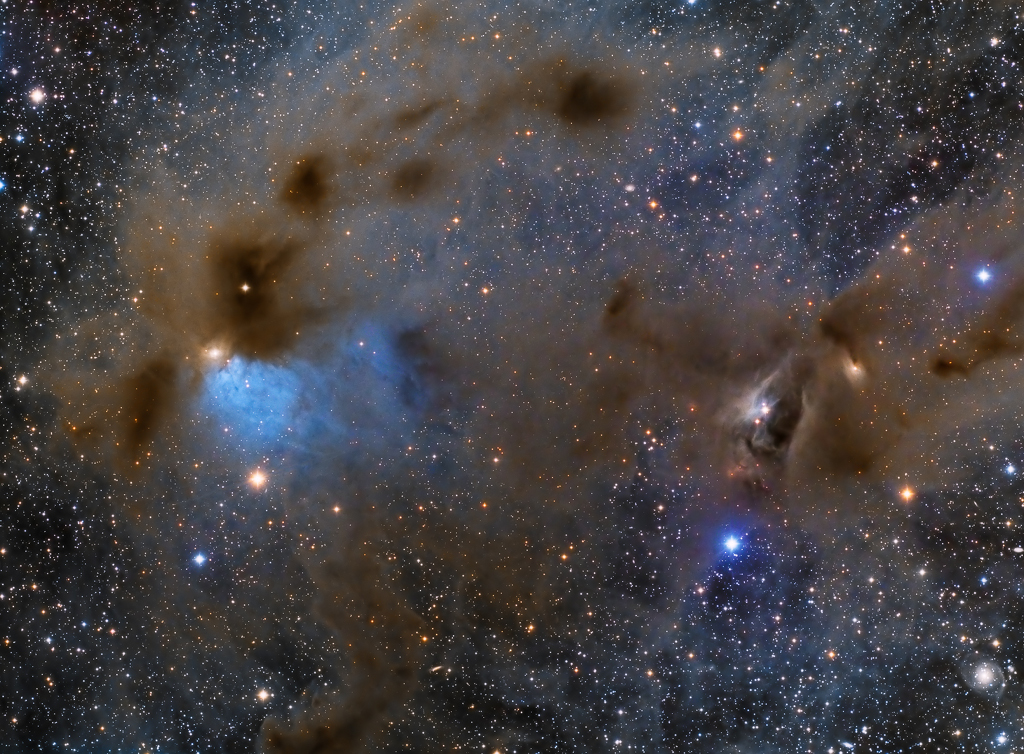
Young Stars and Dusty Nebulae in Taurus

This complex of dusty nebulae lingers along the edge of the Taurus molecular cloud, a mere 450 light-years distant. Stars are forming on the cosmic scene. Composed from almost 40 hours of image data, the 2 degree wide telescopic field of view includes some youthful T-Tauri class stars embedded in the remnants of their natal clouds at the right. Millions of years old and still going through stellar adolescence, the stars are variable in brightness and in the late phases of their gravitational collapse. Their core temperatures will rise to sustain nuclear fusion as they grow into stable, low mass, main sequence stars, a stage of stellar evolution achieved by our middle-aged Sun about 4.5 billion years ago. Another youthful variable star, V1023 Tauri, can be spotted on the left. Within its yellowish dust cloud, it lies next to the striking blue reflection nebula Cederblad 30, also known as LBN 782. Just above the bright bluish reflection nebula is dusty dark nebula Barnard 7. via NASA http://ift.tt/2o9e3rJ
Subscribe to:
Posts (Atom)